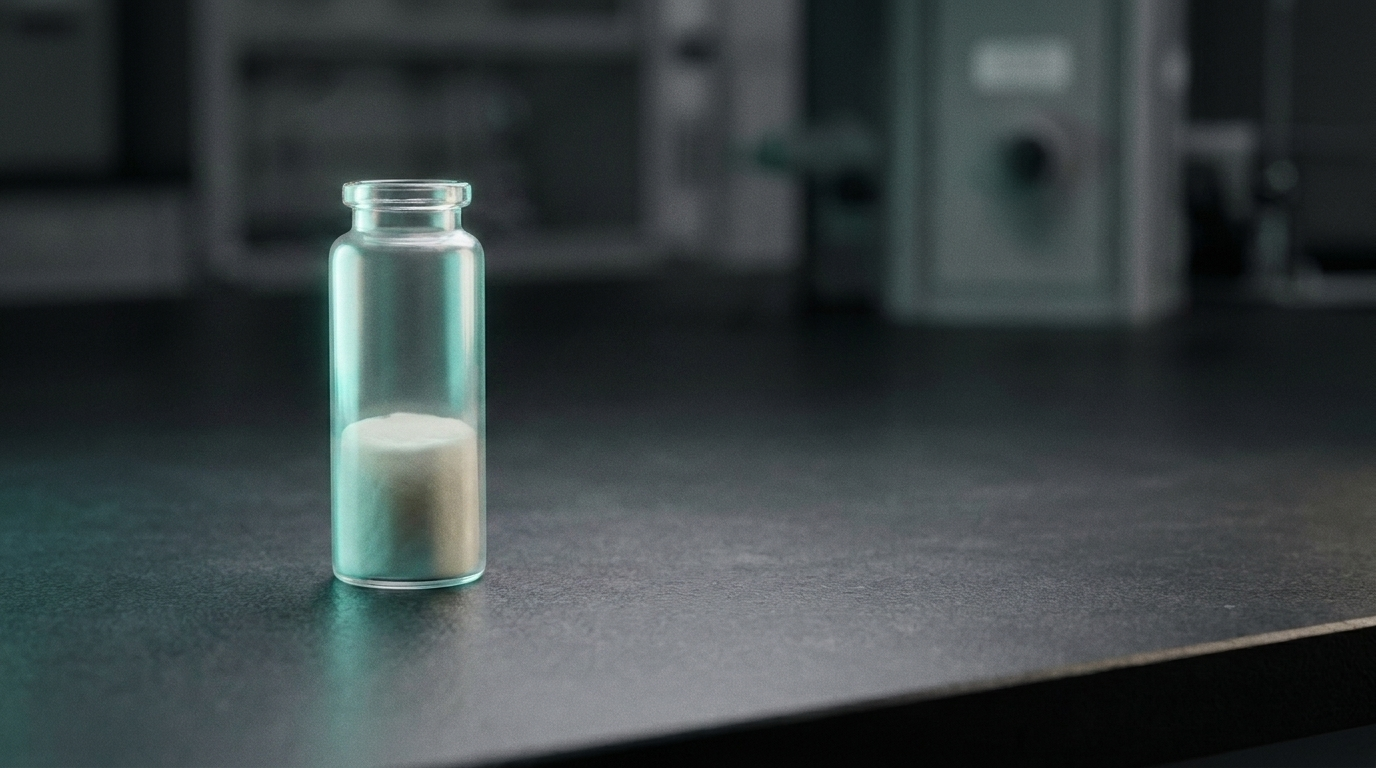

Most research peptides arrive as a fine, dry powder or a light film at the bottom of a vial. That form is the result of lyophilization — freeze-drying — and it exists for a practical reason: peptides in solution are far less stable than peptides kept dry.
Lyophilization removes water through sublimation, the direct transition from solid to vapor without passing through a liquid phase. The process runs in three stages. First, the peptide solution is frozen, locking water into ice crystals. Second, in primary drying, the surrounding pressure is lowered and gentle heat is applied so that the ice sublimes away as vapor rather than melting. Third, in secondary drying, residual bound moisture is driven off, leaving a dry cake with very low water content.
The benefit is stability. Water is a participant in many degradation reactions — hydrolysis, oxidation, and microbial growth all depend on it. Remove the water and those pathways slow dramatically, which is why a lyophilized peptide can be stored and shipped with far less risk of breakdown than the same peptide in liquid form. Freeze-drying is also gentle: because it avoids high heat, it preserves delicate molecular structures that thermal drying might damage.
There is a handling consequence worth knowing. Because the product is dry, it must be reconstituted with an appropriate solvent before use, and it should be stored correctly until then. The freeze-dried state is what makes the peptide durable in transit; proper storage and careful reconstitution are what preserve that quality once it reaches the lab.